
 Attribution (CC BY) "This license lets others distribute, remix, tweak, and build upon your work, even commercially, as long as they credit you for the original creation." (About the Licenses, n.d.)
 Attribution-ShareAlike (CC BY-SA) "This license lets others remix, tweak, and build upon your work even for commercial purposes, as long as they credit you and license their new creations under the identical terms." (About the Licenses, n.d.)
 Attribution-NonDerivs (CC BY-ND) "This license allows for redistribution, commercial and non-commercial, as long as it is passes along unchanged and in whole, with credit to you." (About the Licenses, n.d.)
 Attribution-NonCommercial (CC BY-NC) "This license lets others temix, tweak, and build upon your work non-commercially, and although their new works must also acknowledge you and be non-commercial, they don't have to license their derivative works on the same terms." (About the Licenses, n.d.)
 Attribution-NonCommercial-ShareAlike (CC BY-NC-SA) "This license lets others remix, tweak, and build upon you work non-commercially, as long as they credit you and license their new creations under the identical terms." (About the Licenses, n.d.)
 Attribution-NonCommercial-NonDerivis (CC BY-NC-ND) "This license only allows other to download your works and share them with others as long as they credit you, but they can't change them in any way or use them commercially." (About the Licenses, n.d.)
Here is a clever info-graphic to help you understand which license you need (click info-graphic to go to it's creators home and see it full size).
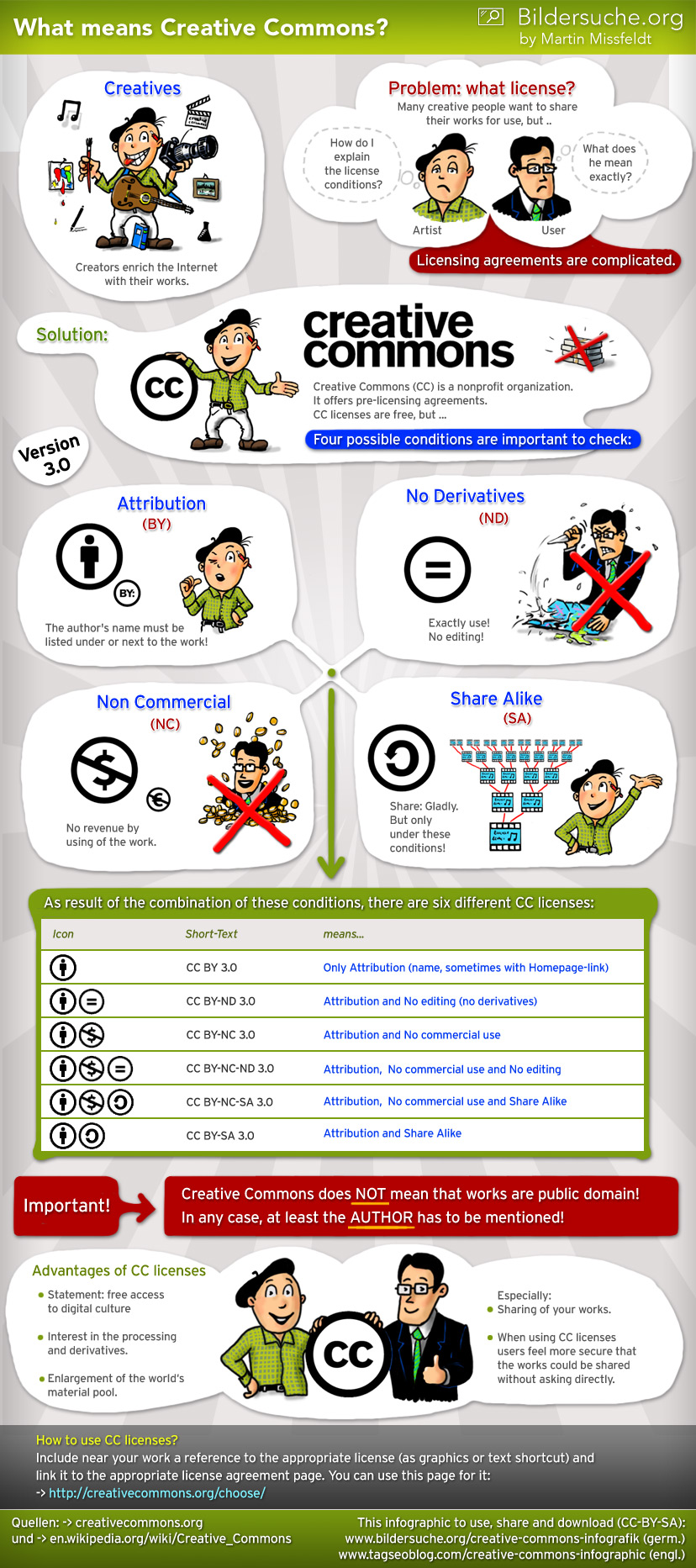
As you can see Creative Commons is a new way to think about Copyright for the current day. With computers and the Internet sharing has become ubiquitous. Without an equally current way to protect the rights of creative people and their property we will continue to move toward an ever more litigious culture where accidental or innocent use of easily obtained media could cause more and more problems. Creative Commons seeks to remedy this with its idea that this is a world where we share things on a daily basis, and as long as one is willing to give credit where credit is due, permission is granted. And after all, isn't sharing what we teach our kids at an early age? This make great sense to me!
Creative Commons (n.d.). About the Licenses. Retrieved from http://creativecommons.org/
Missfeldt, Martin (2012) What means Creative Commons [infographic] Retrieved March 29, 2013 from http://www.tagseoblog.com/what-means-creative-commons-infographic